
Open Electricity Dispatch — November 2025

Each month, we round up the most interesting shifts in the grid – new records, infrastructure updates, and other signals of change in Australia’s electricity system.

What caught our eye this month:
☀️ Renewables exceeds coal in NSW🔋 Battery high in QLD⚡ Monthly RE high in SA🔥 Lowest monthly gas in SA
The end of November marks the close of the spring ‘shoulder season, where demand is low but renewable generation is high, and generally delivering the lowest coal burn of any season.
This year, Victoria experienced this drop most acutely in the NEM. The state saw a drop in coal generation of about 12% compared to last spring. This was partially driven by continued outages at each coal generator, including Yallourn, with one unit not expected to return until late January.
Some of this reduction in coal was replaced by gas, though the technology with the largest increase in absolute terms was wind, with the Golden Plains Wind Farm, the state's largest, contributing greatly.
View all records for the month of November.
Here’s your monthly dispatch from Open Electricity:
Notable Records:
Queensland set a new monthly record for battery discharge in November, with utility scale batteries delivering 61 GWh – a 42% increase from the previous record of 43 GWh, set in September. The state has 12 active batteries, seven of the eight having commenced this year, which is providing strong month-on-month growth.
While individual facilities, such as Tarong and Brendale, have seen considerable growth in November, overall utilisation is still in its early stages. Queensland ended the month with 4,229MWh of installed storage capacity and recorded a weighted average of about 0.48 cycles per day. Last month‘s record discharge is therefore occurring well before the fleet reaches its full operating potential.
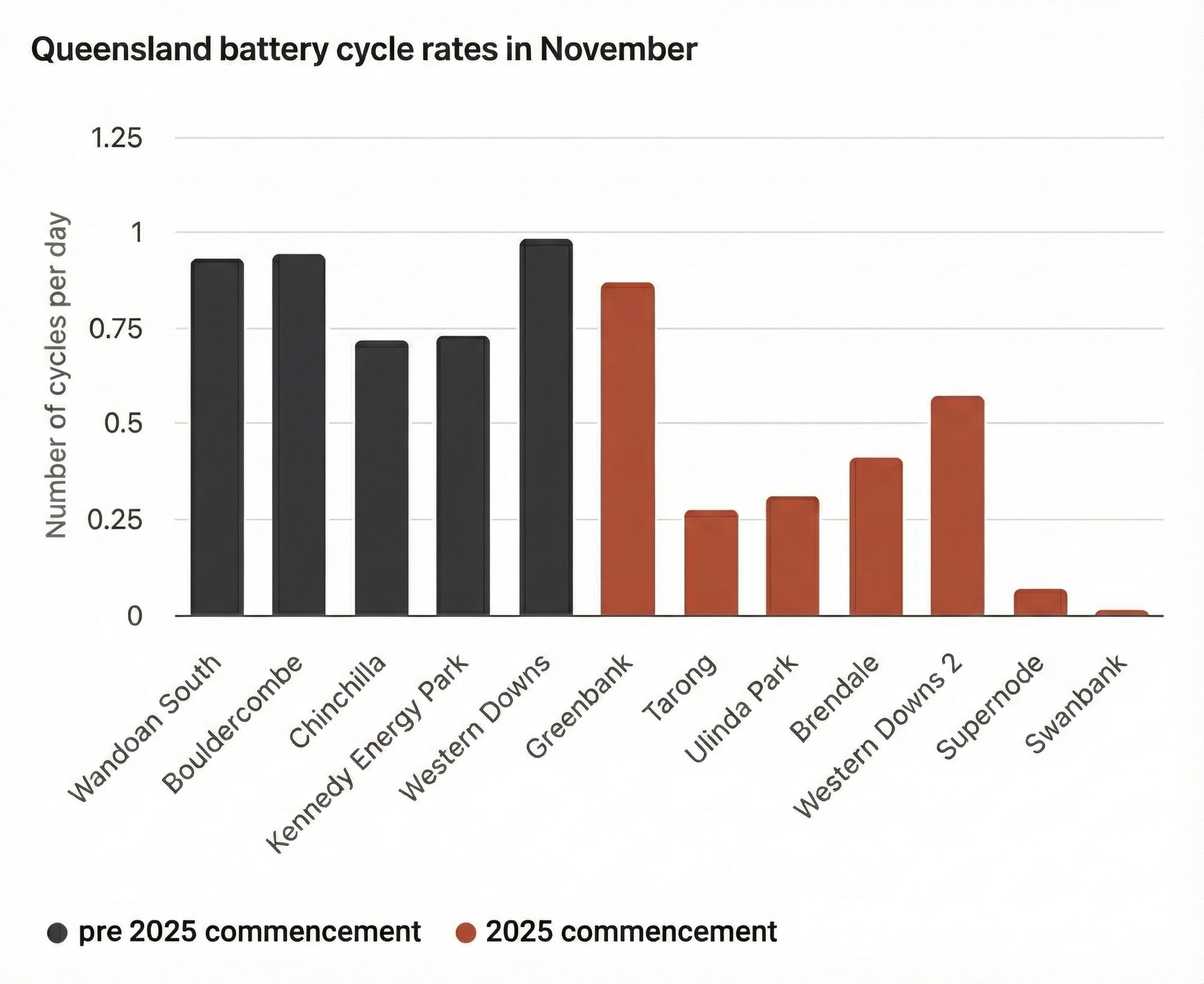
Two batteries saw particularly strong growth in November. Tarong and Brendale each discharged 4.8GWh and 5GWh respectively,more than 10 times greater than recent months. As the utilisation chart shows, both facilities are still operating well below their eventual capacity, cycling only 0.27 and 0.41 times per day – far from the levels we can expect once commissioning is complete.
This expansion in activity also pushed Queensland’s instantaneous record sharply higher. The state exceeded 1 GW of battery discharge for the first time in November, reaching 1,281 MW on 28 November. This is now the highest instantaneous battery discharge recorded in any state, and Queensland becomes only the second jurisdiction, alongside Victoria, to cross the 1 GW threshold.
2. Highest renewable generation in SA over a calendar month (and lowest gas generation)
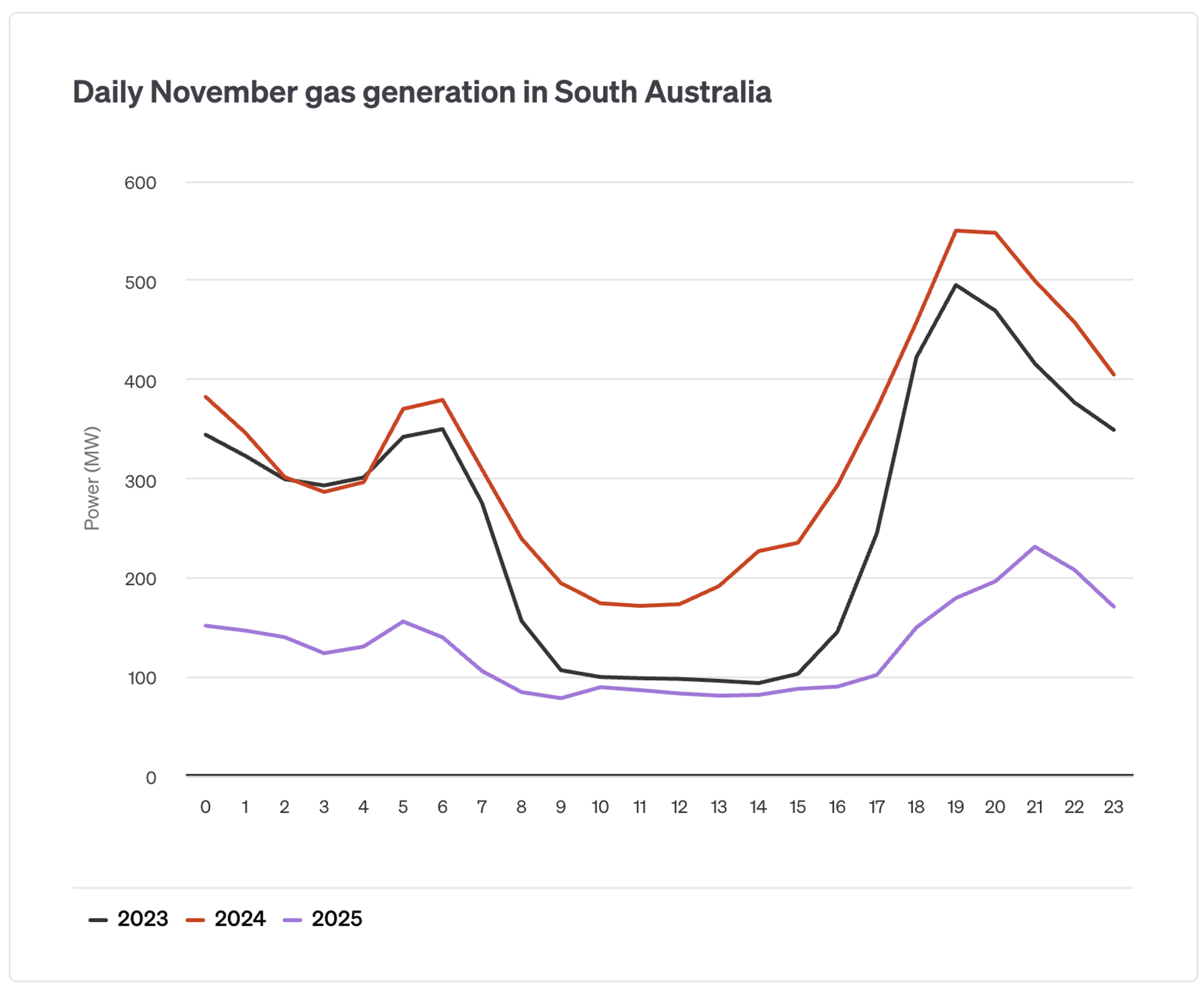
South Australia posted both its highest monthly renewable generation and its lowest monthly gas generation on record. Renewable generation reached 1,063 GWh in November, edging past the previous high of 1,049 GWh set in January 2025. Gas generation, by contrast, fell sharply to 92 GWh – 31% below the 135 GWh recorded in October 2024.
With no coal or hydropower in its mix, South Australia’s gas usage is typically large and highly variable, responding closely to changes in wind output and demand. In November, the sharp fall in gas generation is best explained by sustained wind conditions alongside only modest changes in demand. Most of the reduction in gas generation occurred overnight as well as during the evening peak, and wind output was higher across all hours of the day.
3. Renewables exceed coal generation over a calendar month in NSW
NSW set two new monthly records in November, with renewable generation reaching 2,932 GWh and coal generation falling to 2,880 GWh – the first time the state has produced more renewable electricity than coal across a full month.
Three of the state’s largest solar farms – Wollar, Walla Walla and Stubbo – commenced operation in late 2024. Together, they represent almost one fifth of the state’s utility-scale solar capacity, and their contribution supported consistently strong solar output throughout November, although not quite to the level of the December solar record.
Lower demand meant coal output fell to its lowest level on record, beating the previous low set only a month earlier. Unlike in Victoria, where outages and new renewable capacity have contributed to a substantial decline in coal generation in recent years, NSW and Queensland coal output has remained comparatively high throughout 2025. Last month however, a combination of softer consumption and stronger solar generation pushed NSW coal generation nearly 10 percent below the same month last year.
October saw the first month ever in which renewables exceeded fossil generation across the entire NEM, driven by strong results in SA, Victoria and Tasmania. One month later, NSW has now achieved the same.
Facilities Update
Swanbank
The Swanbank Battery has now entered the Queensland grid. The 250 MW / 500 MWh facility, owned by the state-owned CleanCo, is located on the former Swanbank A and B coal fired power station site, and near the currently operating Swanbank E gas fired power station. Construction began in February 2024, and the battery is expected to reach full operational capability in 2026.
Elaine + Golden Plains
Construction has commenced on the Elaine Battery in Victoria. The 311 MW/1,244 MWh battery will be the third largest in the state, behind the recently added Melbourne Renewable Energy Hub and the Woreen BESS, which is currently under construction. It is also the third largest battery of the developer Akaysha, behind the Waratah Super Battery and the Orana BESS, both in NSW. With this addition, Akaysha has the largest battery portfolio having met financial close.
TagEnergy has also confirmed a battery will be built at the site of the Golden Plains Wind Farm, also in Victoria. Construction of the 150 MW/600 MWh facility is expected to begin in Q1 2026, with commencement in 2027.
Glenellen + Gunsynd + Goorambat
Three new solar farms have begun operation: Glenellen, Goorambat East and Gunsynd. Together, they add 736 MW of new utility scale solar capacity to the NEM.
While not yet committed, the Gunsynd solar farm also has a battery proposed for the site. Of the 12 solar farms now under construction in the NEM, eight have colocated batteries to help manage price fluctuations. The Gunsynd solar farm is also unique in that it is the first facility of Singapore-based developer Metis.
Pelican Point construction
Engie has begun construction on the Pelican Point battery in South Australia. South Australia currently has 1,503 MWh of battery storage operating, though now with the 200MW/400 MWh battery expecting to commence in late 2027, the batteries under construction amount to 900MW/2,280MWh, more than doubling current capacity in the next two years. The Pelican Point battery is located at the site of the currently operating Pelican Point Power Station, though the existing gas plant will likely operate for some time, with an expected closure date of 2037.
___
See all records and the latest facilities updates at Open Electricity.
If you’ve subscribed to OpenNEM or Open Electricity email updates in the past, we highly recommend signing up again (in footer). We’re rebuilding our list from scratch, and we don’t want you to miss out.